
Visa for moving to Switzerland The optimal setup for your emigration and entry into Switzerland with DACHSER & KOLB
People who move to Switzerland appreciate the high quality of life and economic stability. Thanks to the Agreement on the Free Movement of Persons, moving to Switzerland is easier for citizens of the EU and EFTA, but it is by no means informal. Without the appropriate residence permit, you will not have the basis for a rental agreement, bank account, or legal employment. While customs clearance of your household goods is a separate issue, your personal status forms the legal basis for your emigration.
DACHSER & KOLB provides you with a structured overview of the various residence permits (L, B, C, and G), the 14-day registration period, and the requirements for cross-border commuters and pensioners.
When is visa-free entry into Switzerland no longer sufficient?
Although EU citizens do not need a visa for tourist stays, there are clear rules for moving to Switzerland and changing your place of residence:
- 90-day rule: Without a permit, you may stay in Switzerland for a maximum of 90 days per half-year (for tourism purposes only).
- Employment: As soon as you start a job or become self-employed, you are required to register or obtain a permit from the first day.
- Change of residence: Anyone who wishes to live in Switzerland permanently must report to the residents' registration office of their municipality of residence within 14 days of entering the country (and before their first day of work).
- Importing household goods: Customs will only recognize your household goods as duty-free relocation goods if you can provide proof of your change of residence (such as an employment contract or rental agreement).

The Swiss entry and residence system – short stay vs. taking up residence

Short stay (up to 90 days) – Schengen logic
- Visa C (Schengen visa): for stays of up to 90/180 days; reasons include tourism, visits, business, and study.
- Important: A visa alone is not sufficient for gainful employment—depending on the case, a work permit may also be required.
- Documents for third countries: Travel document generally valid for at least 3 months beyond the planned departure date and issued within the last 10 years.
- Travel health insurance (for visa C): Proof required (coverage up to EUR 30,000 for defined types of costs).

Long-term stay (> 90 days) – Taking up residence & permits
- For stays longer than 90 days, a residence permit is required (issued by the cantonal migration office).
- EU/EFTA: Registration in the municipality of residence within 14 days of arrival and before starting work.
- Visa D (national): for stays longer than 90 days, including employment, education/training, family reunification.
- Processing logic: Visa D is subject to cantonal jurisdiction (permit); duration varies by canton, but as a rule, allow at least one month.
Related topics
- Swiss customs regulations → Find out more now
- Emigrating to Switzerland? → All the important information
- Bringing your pet with you? → Import regulations
- Moving to Switzerland → What you need to know
The Swiss permit system – The various types of foreigner permits

Which permit is right for your life situation?





6 steps to obtaining the right visa for your move to Switzerland
Analyze your life situation and goals
Length of stay, start of employment, family structure, start of school/studies, pets, vehicle, volume of household goods.
Status check: EU/EFTA vs. third country + purpose
This determines the visa/approval route (visa-free, visa C, visa D, registration procedure, etc.).
Prepare documents
Passport/ID, employment contract, rental agreement, civil status documents, translations/legalizations if necessary, proof of insurance (depending on the case).
Prepare application documents
- Visa C/D via the relevant Swiss representation or processes in accordance with SEM.
- EU/EFTA: Municipal registration within the deadline; short-time work via online registration procedure if necessary.
Synchronize visa timing with relocation and customs
Customs window, border customs office (commercial goods), inventory list, powers of attorney—so that the truck is not “parked” but cleared through customs.
On-site onboarding
Registration/administrative procedures, insurance, vehicle matters (if applicable, cantonal), forwarding of mail/remaining deliveries.
What setup do you need for your long-term stay in Switzerland?

Family reunification
Spouses and children under the age of 21 may relocate subsequently if they can provide proof of a suitable place of residence.

Prospective job offer
Permit B (or L for short-term contracts); employment relationship of 3 months to 1 year: entitlement to EU/EFTA L permit

Retirement
Retirees must prove that they have sufficient assets to avoid having to rely on social assistance and must take out health insurance.

University, school, and continuing education
Proof of enrollment and sufficient financial resources required. In practice, often visa D + cantonal permit (depending on nationality and setup).

Cross-border commuter
Residence remains abroad, work in Switzerland; usually weekly return to the main residence abroad = G permit

Third countries – Working in Switzerland
Typically only granted to highly qualified professionals; employers must prove, among other things, that no suitable candidates from Switzerland/the EU/EFTA are available and that the conditions are in line with market standards.
Common mistakes when entering Switzerland – and how to avoid them

-
Missing the registration deadline: The 14-day deadline is strict. Late registration can result in fines.
-
Forgetting health insurance: Insurance is compulsory in Switzerland. You have three months to register, but you must pay retroactively from the date of entry.
-
Starting work without registering: You may only start working after registering with the local authorities.
-
Status vs. customs: Please note that your personal entry permit does not automatically guarantee duty-free import of your car. Details can be found on our here.
How DACHSER & KOLB supports you with visa setup for your move to Switzerland

Coordination and timing
Synchronization of entry date, approval/registration processes, customs windows, and transport times – so that your removal goods arrive when the formalities are “green.”

Documents and inventory
Preparation of customs documents (e.g., inventory logic) and clear structure for fast clearance.

Customs clearance & border coordination
Planning suitable customs offices/opening hours and process management to ensure that border crossings function smoothly.
Entry & removal goods: Importing removal goods into Switzerland (without friction losses)
- Duty exemption only for change of residence: Only those who can prove that they are moving to Switzerland may import their used household goods duty-free.
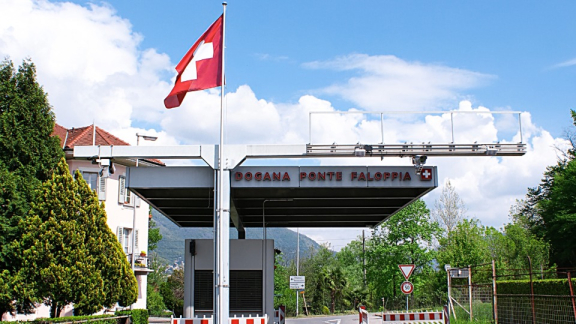
- The “key moment” at the border: When you arrive at the border with your moving van, the customs officer will ask you to present Form 1844 and proof of your right of residence.
- EU/EFTA immigration: As a rule, no “assurance of a residence permit” is required for customs; proof of change of residence is provided, for example, by an employment/rental contract or confirmation of deregistration.
- When moving with animals: Requirements vary depending on the country of origin; the basic requirements include a microchip, pet passport, and valid rabies vaccination. The following applies to pet conditions: max. 5 animals (otherwise commercial purpose rules apply).
You can find more information about customs regulations for Switzerland here.
Legal notice
This page is intended as practical guidance and does not replace individual legal advice. The current requirements of the relevant authorities, in particular SEM (entry/visas/permits), FDFA (entry & residence), FDPIC (customs/household goods) and FVO (entry of pets), are binding.
FAQ – Frequently asked questions about visas for moving to Switzerland
Do Austrians need a visa for Switzerland?
No, a valid identity card is sufficient for entry. However, a permit (L or B card) is mandatory for permanent residence.
How long will it take to receive my foreigner's identity card?
After registering with the local authorities, processing usually takes between 2 and 6 weeks, depending on the canton. During this time, the registration confirmation serves as an official document.
How much does the residence permit cost?
The fees vary depending on the canton and type of ID, but are usually between CHF 65 and CHF 150 per person.
How long can I stay in Switzerland without a visa?
Short stays are generally limited to 90 days within a 180-day period (Schengen rule).
What is the difference between a C visa and a D visa?
Visa C: up to 90/180 (Schengen). Visa D: over 90 days (national), e.g., work, education, family reunification.
Do I have to register after entering Switzerland?
When taking up residence as an EU/EFTA citizen: register with the local authorities and apply for a permit within 14 days of arrival and before starting work.
What is the online notification procedure (EU/EFTA)?
For certain short-term employment activities (up to 3 months/90 days within a calendar year), the registration procedure is used.
Why DACHSER & KOLB is the right choice

Personalized consultation
Detailed needs analysis for customized relocation solutions.

Relocation planning from A to Z
Complete relocation planning: from packing to unloading, all from a single source.

Reliable network
Global network for safe, seamless transport.
We are here for you
Were we unable to answer your questions about entering Switzerland?
Then please do not hesitate to contact us.